With no resources and no help at the start, four women created a learning space from nothing and changed the future of children in their community.
Before the Supervised Neighborhood Play (SNP) site existed in this Bicol community, early learning depended on chance. Some days, children gathered in the chapel. Other days, a neighbor’s home served as a venue for learning. When neither was available, sessions were canceled. Parents wanted their children to learn, but there was no stable place to bring them.
Supervised Neighborhood Play is a community-based day care program for children aged three to six. Learning happens through guided play, movement, songs and simple routines led by trained child development workers and parent volunteers, with oversight from a social worker. For many children, SNP is their first experience of structured learning in a familiar, neighborhood setting.
This kind of access matters. Many Filipino children enter school without adequate preparation, especially in communities where formal early learning centers are limited. Programs like SNP help address this gap by nurturing not only early literacy and numeracy, but also confidence, cooperation, creativity, and social skills that children need to succeed in school.

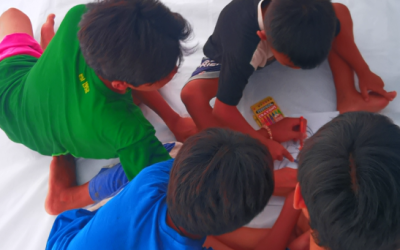
Children at the SNP paying close attention during a session.
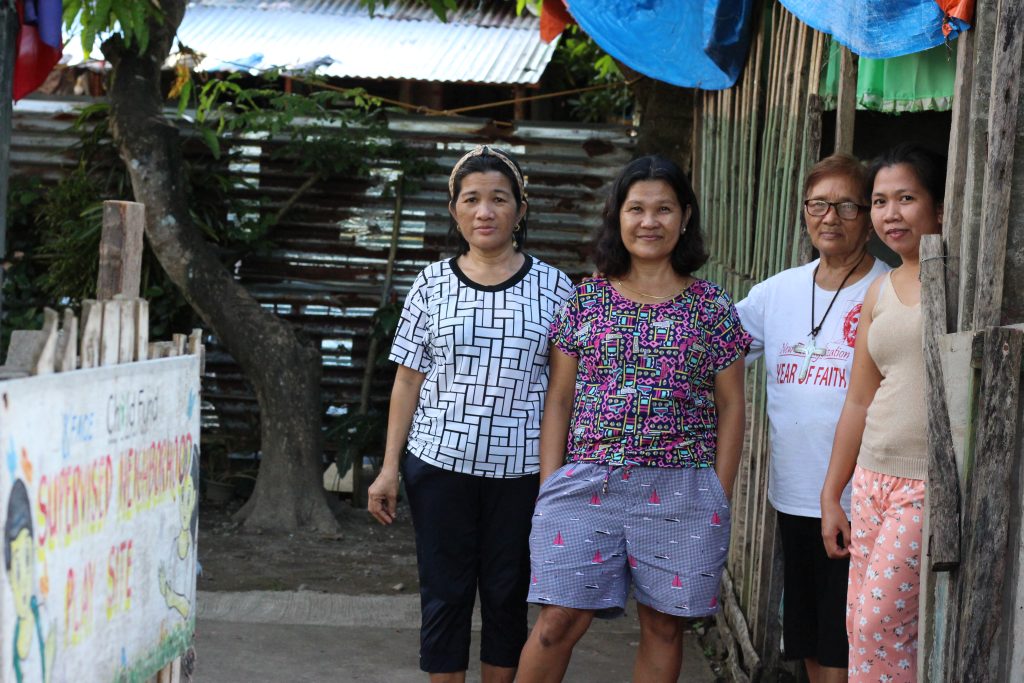
Arlene, a mother and long-time community volunteer, first learned about ChildFund and FACE Incorporated’s SNP program nine years ago during a neighborhood meeting. She was told the role required patience and sincerity. “They said the person needed a heart for this,” she recalled. “I said yes.”
After attending trainings, Arlene began facilitating SNP sessions for toddlers and preschool-aged children. Sessions included tracing letters, counting, identifying shapes, singing movement songs, and practicing social interaction. Children as young as two would eagerly wake their parents in the morning, excited for their “school day.” But the absence of a consistent venue remained a challenge that disrupted the rhythm of learning.

Years later, the solution emerged not from outside support but from the resolve of four women, Arlene and three neighbors: Meriel, Rosalina, and Binyang. Together, they decided that if no permanent space existed for the children, they would build one themselves.
It was an idea that began quietly. Arlene mentioned the difficulty of inconsistent venues, and the women responded with action rather than discussion. They approached their homeowners’ association and asked permission to use a vacant spot of land. Once they received approval, they gathered the only resources they had: determination, scraps of wood, and the belief that their children deserved a place to learn.
Meriel, a 31-year-old mother, explained her motivation simply, “We just wanted our children to learn. My child was part of SNP, so I thought we should help build it.” She had seen her child grow more social and confident, and knew other children needed the same opportunity.
Rosalina, a 53-year-old grandmother who sometimes earned income through sewing, shared that she was inspired when she realized the children needed a safe, open space. “In the chapel, they were confined. Here, they could move freely because it was fenced and away from the road,” she said. At first, she admitted she did not fully understand the value of SNP, thinking play could simply happen indoors at home. But after witnessing how her own grandchild changed, becoming more confident, less fearful, and able to trace letters on her own, she said, “I was surprised. I saw there was real knowledge here. Not just play.”
Then there was 82‑year‑old Binyang, whose presence in the construction group astonished many. “I saw how dedicated Arlene was,” she said. “So I joined, because I knew it would help the children.” She described how the site had once been a place for dumping scraps and cockfighting. When a few neighbors tried to continue using the space that way, she stood watch alone to keep it clean. “I guarded it so no one would dirty or destroy it,” she said. “This was my help to Arlene and to the community.”

Their first construction team was entirely composed of women. They gathered coco lumber and nails, some donated by neighbors who saw them working. They hammered beams into place, nailed planks of wood and tarpaulins for walls, and patched gaps with whatever materials they could find. They also built the fence around the area with their bare hands. One brought snacks for the group, another fetched tools. They worked through heat, through rain, and through days when the ground softened under their feet.
Arlene described watching the women lift lumber and build walls despite never having done this kind of work. “We were all women,” she said. “But we worked together. When neighbors saw us, they started helping too.” Only later did three fathers volunteer to help with the roofing, but by then, the main structure already stood, a testament to the force of four women who refused to wait for assistance.
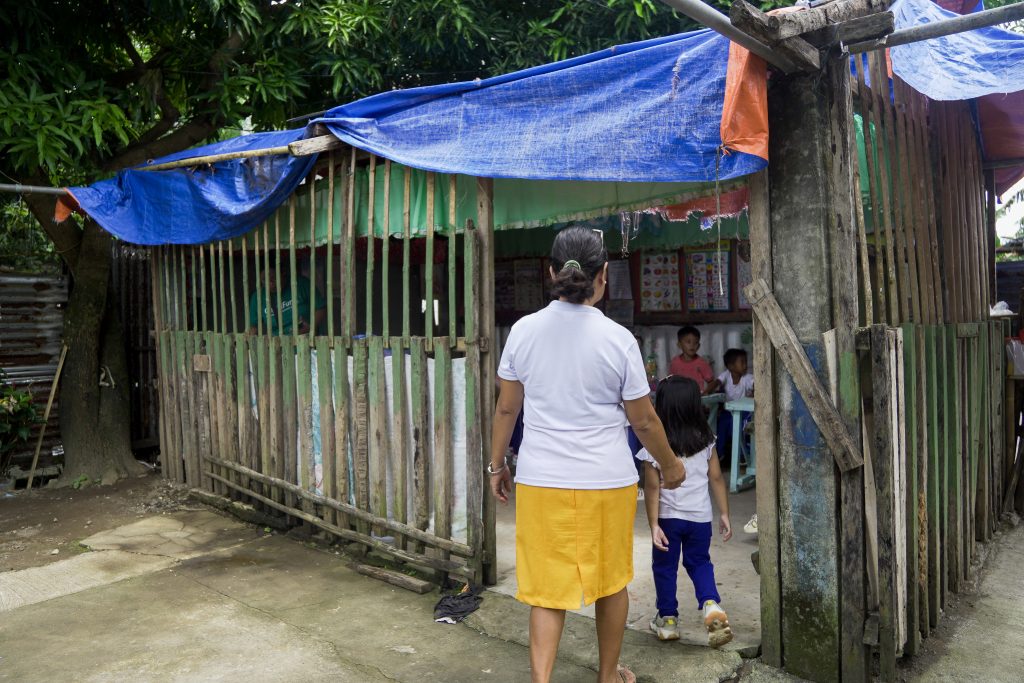

When the SNP site was finally ready, the children filled it with energy and color. In the airy, handmade space, they traced their first letters, learned to count, and practiced sharing and speaking up. Parents noticed changes immediately: children became more independent, more attentive, and more confident when entering kindergarten. Some later became honor students, a transformation that reinforced the importance of early learning in the community.
Their efforts reflect what Philippine law has long recognized*. National Early Childhood Care and Development (ECCD) policies allow for home-based and community-based programs like SNP, yet these approaches remain underused. The site built by these women shows what is possible when communities act on their own knowledge of what children need.
For Arlene, the site is more than a physical structure. It is a place where children discover their abilities, and where women in her community discovered their own. She often reflects on how children who passed through her SNP sessions return years later to thank her. She hopes they remember the small space where they first traced letters and sang songs and remember too the women who built it.
The SNP site stands today because four women looked at an unused lot and saw potential. They built something solid, meaningful, and lasting, not just for their own children, but for the entire neighborhood. Their hands built the walls, but their conviction built the foundation.
And in that foundation lies a story of women who understood that when learning has no place, sometimes you have to build one.

Supervised Neighborhood Play is part of ChildFund’s Ensuring Nutrition, Health, and Children’s Early Stimulation and Learning (ENHANCE) program.
* As early as Republic Act No. 10410, the law explicitly provided for home-based programs—including neighborhood-based play groups, family childcare programs, and parent education and home visiting programs—as legitimate ECCD delivery mechanisms (Sec. 4 of Republic Act No. 10410). This mandate was retained and even expanded under Republic Act No. 12199, which further allows for “innovations and alternative modalities” in ECCD service delivery (Sec. 4 of Republic Act No. 12199). Despite this clear statutory basis, the operationalization of home-based and alternative delivery modes remains largely unfulfilled with the national ECCD system continuing to prioritize center-based approaches at the expense of more flexible, community-responsive alternatives.