
As schools remain closed across affected communities, children face growing barriers to education. Providing safe spaces, learning materials, and support is key to helping them continue learning despite the crisis.
By Check Zabala

Jorge Sabiña of ChildFund facilitates a psychosocial support session for children at an evacuation site in Glan, Sarangani. Photo by Check Zabala
In an evacuation center in Glan, Sarangani, the days no longer follow a familiar rhythm for children.
There are no early mornings for school, no classrooms to return to, and no certainty about when learning will resume. Since the earthquake forced schools to close, thousands of children across Southern Mindanao have been left without access to education. As of June 25, more than 71,000 families have been affected across Tupi, South Cotabato and the municipalities of Malapatan and Glan, Sarangani, with Glan recording the highest number of affected families. For many children, the disruption has not only displaced their routines but has placed their education at serious risk.
In Sarangani alone, the scale of impact on education is severe. More than 5,500 classrooms were either destroyed or heavily damaged by the earthquake, with rehabilitation and reconstruction costs estimated to exceed P13 billion.
As of June 24, reports show that 1,676 schools, 266,001 learners, and 11,557 teaching and non-teaching personnel across five regions and 39 school divisions have been affected.
The damage has significantly disrupted learning for hundreds of thousands of children.

(Left to right) Ben, Anton, and Carl sit outside a child-friendly space (CFS) tent as they wait for a psychosocial support session to begin. Photo by Check Zabala
Among those affected are Anton, 14, Ben, 15, and Carl, 14, not their real names, three childhood friends now living in an evacuation site. Before the earthquake, their days were shaped by school, friendships, and simple routines. Now, their time is spent helping their families, staying close to one another, and waiting for some sense of normalcy to return.
“We don’t go to school because it is still closed because of the earthquake,” Anton said.
“We are still afraid,” Ben added quietly.
For Carl, the situation is even more fragile. Having already stopped going to school last year, the disruption has pushed the possibility of returning even further away. Their experience reflects a wider and urgent challenge. When emergencies interrupt education, the impact can be long lasting. Children lose not only access to lessons, but also the structure, support, and sense of progress that schools provide. The longer they remain out of school, the more difficult it becomes to re-engage, increasing the risk of permanent dropout.

Ben, Anton, and Carl participate in a psychosocial support session for children facilitated by ChildFund and Ha Uman. Photo by Check Zabala
In the evacuation site where they are staying, Anton, Ben, and Carl joined other children in a Child-Friendly Space where ChildFund, together with its local partner Ha Uman, conducted a Mental Health and Psychosocial Support and Psychological First Aid session. While primarily focused on emotional recovery, these sessions also serve as an entry point for learning continuity.
In the absence of formal schooling, even simple, structured activities help children practice core learning behaviors such as listening, following instructions, participating in group work, and rebuilding focus. These are essential foundations that make it possible for children to transition back to formal education when schools reopen.
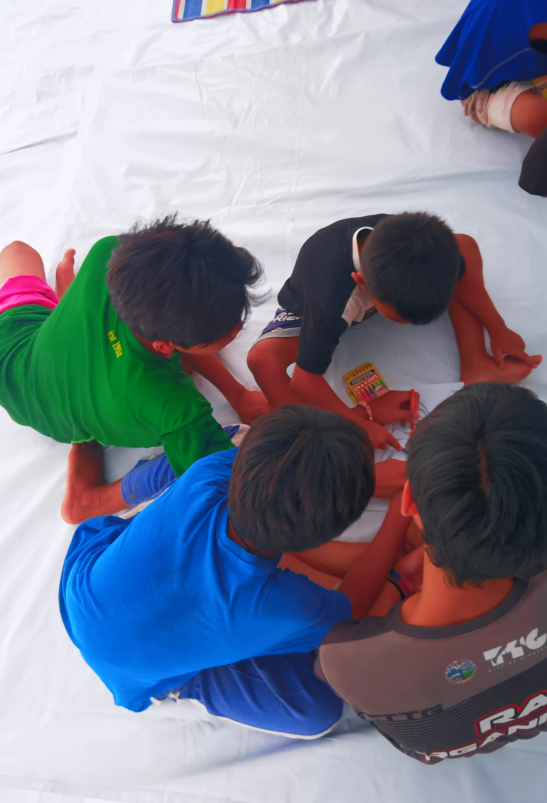
(Left photo) Ben, Anton, and Carl participate in a psychosocial support session for children facilitated by ChildFund and Ha Uman. Photos by Check Zabala
Anton later shared that he enjoyed the session because he feels like a child again. It is a small but important reminder of what has been interrupted. Like many children in crisis, he has had to carry worries beyond his years. Safe and structured spaces allow him, even briefly, to return to a more appropriate stage of childhood where learning and play can coexist.
For Ben, the experience helped ease fear. For Carl, it reopened a connection to learning that had already begun to fade. These changes are subtle, but they are critical. Before children can return to school, they must first feel ready to learn again.

Children play in an evacuation camp in Glan, Sarangani, while waiting for their parents to finish a psychosocial support session facilitated by ChildFund and Ha Uman. Photo by Check Zabala
To sustain this readiness, learning continuity support must go beyond one-time engagements. Children need access to basic school supplies, both for themselves and their teachers, to make learning possible again. They need temporary learning spaces where structured lessons can safely resume, even while schools remain closed or under repair. Without these, the gap in learning will continue to widen.
Across Tupi, Malapatan, and Glan, ChildFund and its partners are working to address this gap by combining Mental Health and Psychosocial Support, Psychological First Aid, multi-purpose cash assistance, and targeted learning continuity interventions. As of June 25, more than 4,000 children and adults have already been reached.
However, the scale of need remains significant.
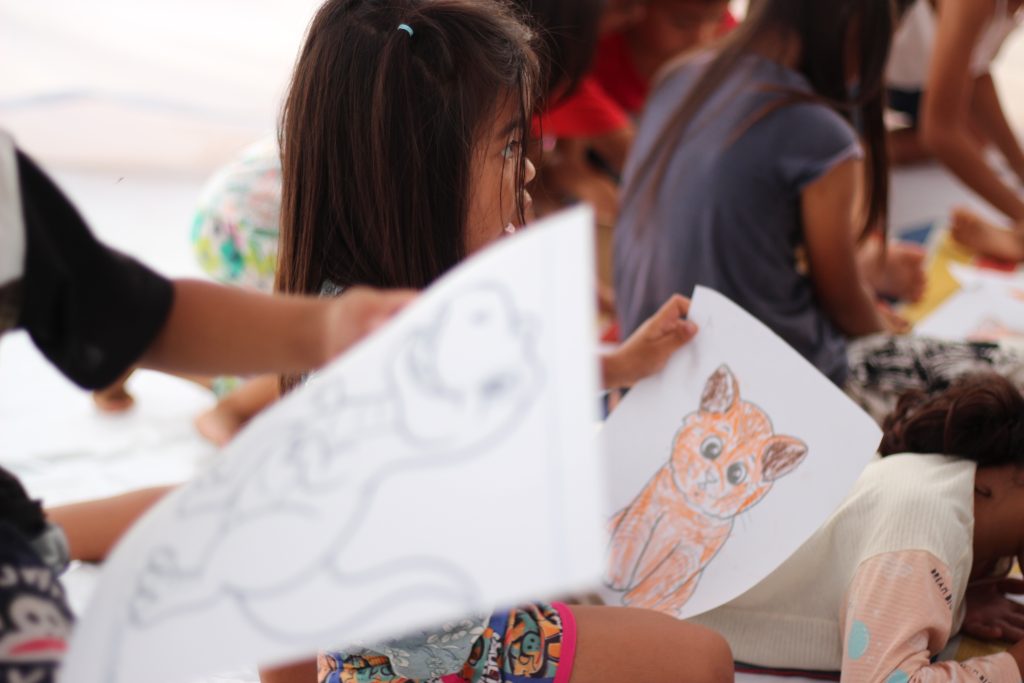
A child in Glan, Sarangani, colors a drawing during a psychosocial support session facilitated by ChildFund and Ha Uman. Photo by Check Zabala
For children like Anton, Ben, and Carl, learning continuity is not just about catching up on missed lessons. It is about preserving their connection to education at a time when it is most at risk. It is about ensuring that when schools reopen, they are not returning as children who have been left behind, but as learners who have remained engaged, supported, and hopeful.
Without timely support, many of these children may never return to school. With the right support, even simple resources such as school supplies, temporary learning spaces, and structured support can make the difference between interruption and recovery.
In the middle of uncertainty, keeping children connected to learning is one of the most powerful ways to protect their future.