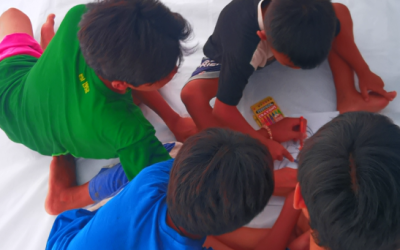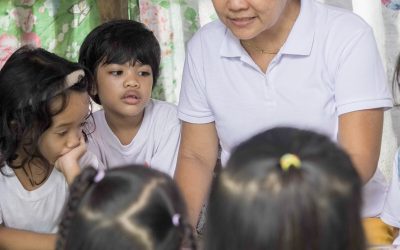
After weeks of supporting children and families affected by the Southern Mindanao earthquake, Child Development Workers in Malapatan were given something they rarely ask for themselves: a chance to heal.
By Check Zabala

Jorge Sabiña of ChildFund creates a safe space for Child Development Workers to reflect, share, and heal during a psychosocial support session in Malapatan, Sarangani. Photo by Check Zabala
June 8, 2026 was supposed to be a day full of excitement for Dulce Esparagoza, a Child Development Worker (CDW) in Malapatan, Sarangani. Parents were gathering for an orientation, while she and her fellow CDWs made final preparations for the opening of classes. Children would soon be returning to the Child Development Center, and for Dulce, it was the beginning of another promising school year.
Then the ground began to shake.
A magnitude 7.8 earthquake struck Southern Mindanao, turning what should have been a joyful day into one marked by fear and uncertainty. Families rushed to safety as homes, schools, and livelihoods were affected by the disaster.
According to the Department of Social Welfare and Development’s (DSWD) Disaster Response Operations Monitoring and Information Center (DROMIC) report as of July 24, 2026, the earthquake affected 15,647 families or 78,316 individuals across 12 affected barangays in Malapatan. A total of 13,784 houses were damaged, including 2,558 that were totally destroyed and 11,226 that sustained partial damage. More than 1,200 families, or 3,745 individuals, remained displaced weeks after the disaster. Beyond the visible damage, the earthquake disrupted daily routines and left many families struggling to regain a sense of normalcy. Children found it difficult to understand what had happened, while recurring aftershocks kept communities on edge long after the initial tremor had passed.

Dulce prepares learning materials at a child development center, continuing her commitment to creating safe and nurturing spaces for young children. Photo by Check Zabala
Amid the uncertainty, Dulce and her fellow Child Development Workers stepped forward to support children and families through one of the most difficult periods their community had faced.
Drawing on skills they had gained through Mental Health and Psychosocial Support (MHPSS) and Psychological First Aid (PFA) training provided by ChildFund and Ha Uman, they organized socialization activities that gave children a safe space to play, talk, and express their emotions. They also worked closely with parents, helping them process their own experiences and better support their children’s emotional recovery.
“It is very important to process what the children went through because it prevents them from having traumas and prevents lingering fear. This helps children continue on with their lives,” Dulce said.

A Child Development Worker facilitates an MHPSS session in Malapatan, Sarangani as part of ChildFund’s humanitarian response. Photo by Check Zabala
For weeks, the CDWs became a source of comfort and stability for children whose lives had been suddenly interrupted. They listened to concerns, facilitated activities, and helped families navigate the emotional aftermath of the disaster.
But while they were helping others heal, many of them were quietly carrying their own emotional burdens.
“We too were afraid. We were affected too. We also have our own families to think about,” Dulce shared.
Like the families they served, the CDWs experienced the shock of the earthquake and the uncertainty that followed. They worried about their homes, their loved ones, and what might happen next as aftershocks continued to be felt across the area. Yet despite their own fears, they continued showing up for the children and communities that depended on them.

Dulce joins fellow Child Development Workers during a debriefing and psychosocial support session, taking time to care for her own well-being after weeks of caring for others. Photo by Check Zabala
Recognizing the emotional toll carried by these frontline workers, ChildFund and Ha Uman gathered more than 50 Child Development Workers in Malapatan on August 6 for a debriefing and refresher session on psychosocial support.
The activity gave participants an opportunity to reflect on their experiences before, during, and after the earthquake. It provided a safe space where they could openly share their fears, process difficult emotions, and learn from one another. More importantly, it reinforced a message that is often overlooked in disaster response: those who care for others need care, too.
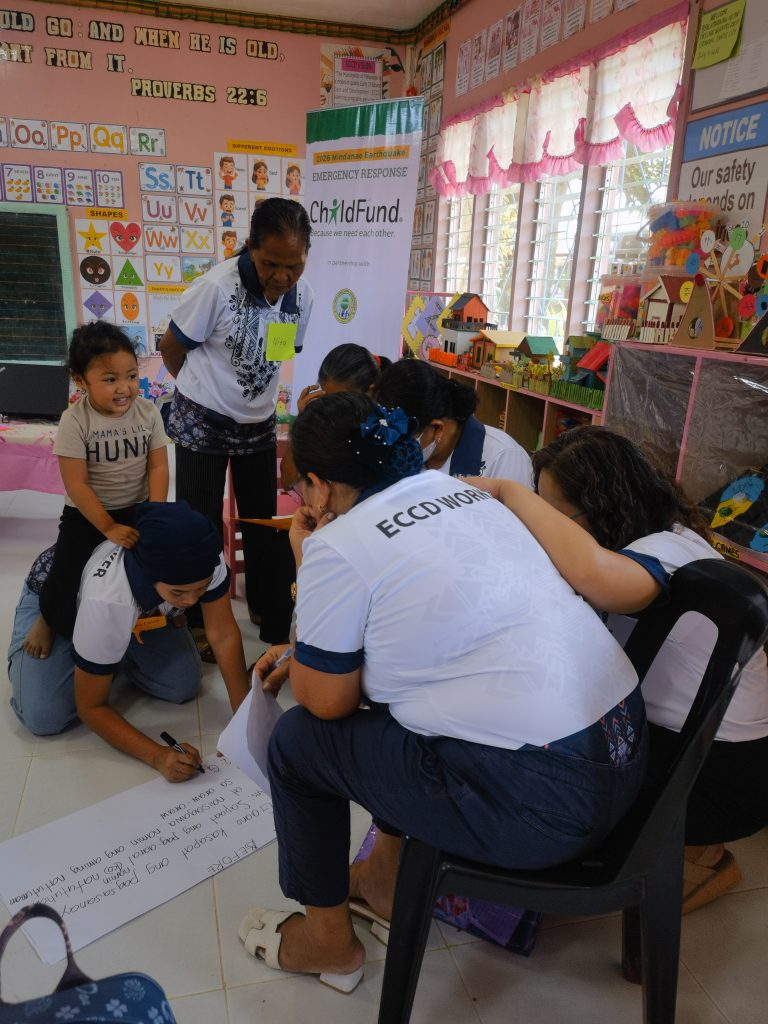
Child Development Workers in Malapatan reflect on their earthquake response experience, sharing lessons, challenges, and moments of resilience during a breakout session. Photo by Check Zabala
For Dulce, the session provided support she did not realize she needed.
“We are thankful to the training provided by ChildFund and Ha Uman because in my many years, we don’t usually get this kind of training,” she said. “It helped us a lot in not just helping the children and their parents, but us too.”
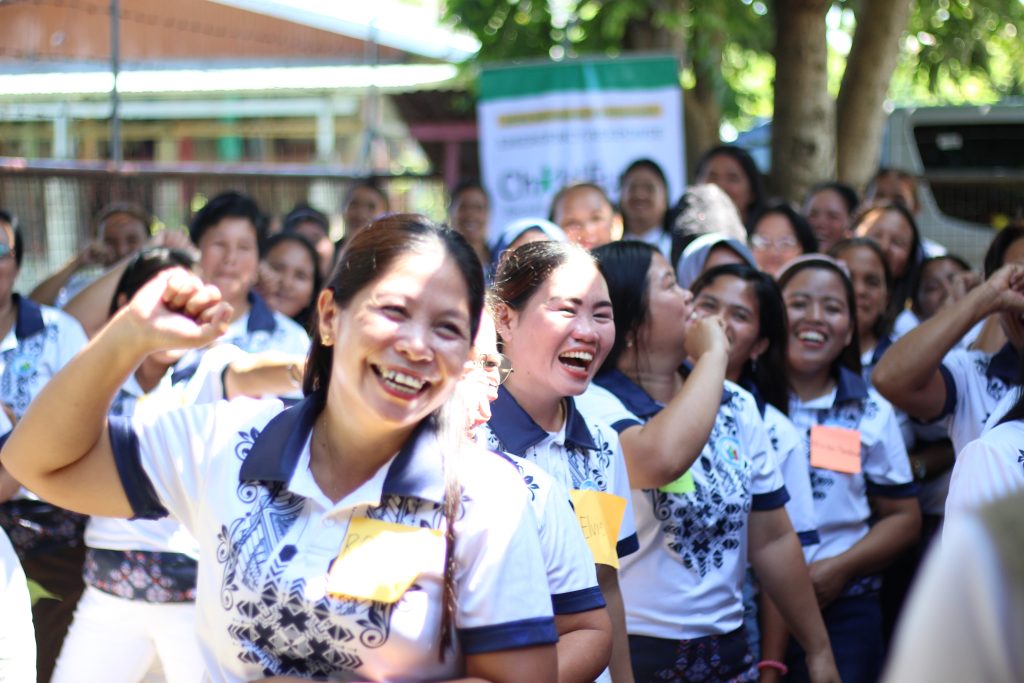
Child Development Workers in Malapatan gather to reflect on their experiences, support one another, and find renewed strength for the work ahead. Photo by Check Zabala.
The debriefing allowed participants to step back from their responsibilities and acknowledge what they had been carrying for weeks. Surrounded by colleagues who had shared the same experience, they found comfort, understanding, and strength.
“The debriefing ChildFund and Ha Uman did today helped us process our own experiences and emotions. Now we can continue on with our work with peace of mind,” Dulce said.

Laughter fills the room as Joy Banusing of Ha Uman facilitates an icebreaker, helping Child Development Workers reconnect with one another after weeks of carrying the weight of disaster response. Photo by Check Zabala
Beyond helping them heal, the session also gave participants an opportunity to reflect on lessons learned and strengthen their preparedness for future emergencies.
“The session today was not just to process our feelings, but to help us in improving the way we do things,” she added. “So if another disaster strikes, we are more prepared and ready.”

Loren Francisco of ChildFund facilitates a psychosocial support session, helping Child Development Workers process their experiences and reconnect with their resilience. Photo by Check Zabala
Two months ago, Dulce and her fellow Child Development Workers were preparing for a parent orientation when the earthquake abruptly changed everything.
Today, they are once again preparing their Child Development Centers to welcome young children back for face-to-face sessions.
The excitement they felt in June has returned, shaped by the difficult lessons of the past two months. While the memory of the earthquake remains fresh and many families are still recovering, the reopening of the centers represents an important step toward restoring normalcy for children and their communities.

Dulce joins fellow Child Development Workers during a debriefing and psychosocial support session, taking time to care for her own well-being after weeks of caring for others. Photo by Check Zabala
After spending weeks helping others heal, Dulce and her fellow Child Development Workers were given the opportunity to heal too. And as children slowly return to familiar spaces, routines, and friendships, they will be welcomed by caregivers who are not only ready to support them, but who have also found renewed peace, strength and confidence within themselves.
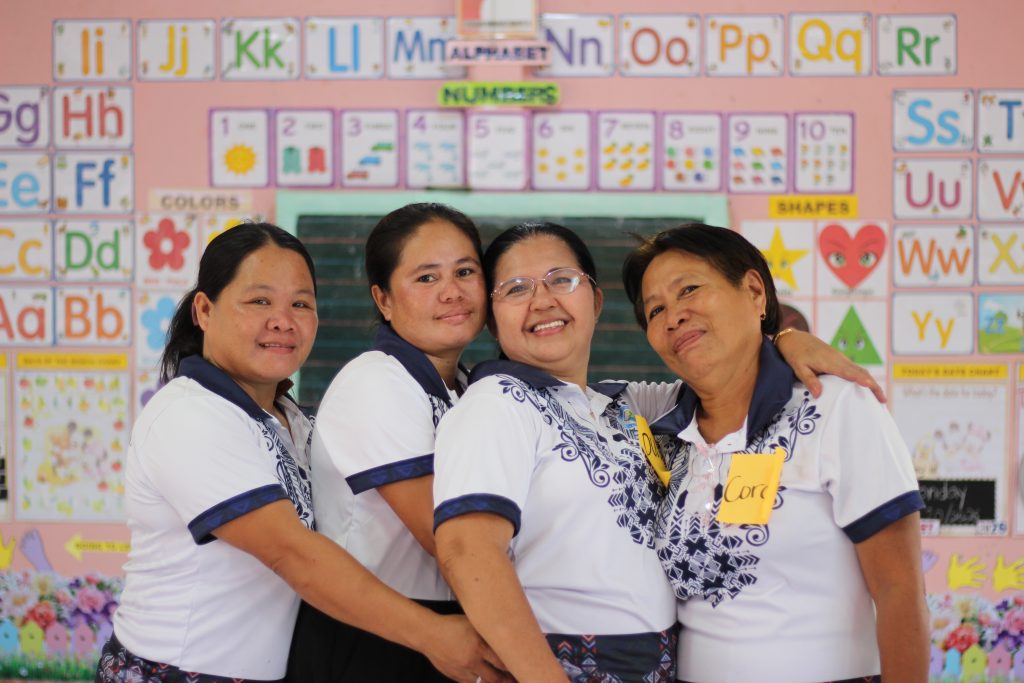
Smiles return as Dulce (second from right) and fellow Child Development Workers celebrate the close of a debriefing session, carrying renewed strength and hope back to their communities. Photo by Check Zabala