Through a project implemented by ChildFund Philippines together with UNICEF, with funding support from the Government of the Republic of Korea through the Korea International Cooperation Agency (KOICA), a community learning center in Maguindanao del Norte is helping young mothers continue their education while providing a safe and nurturing space for their children.
By Check Zabala
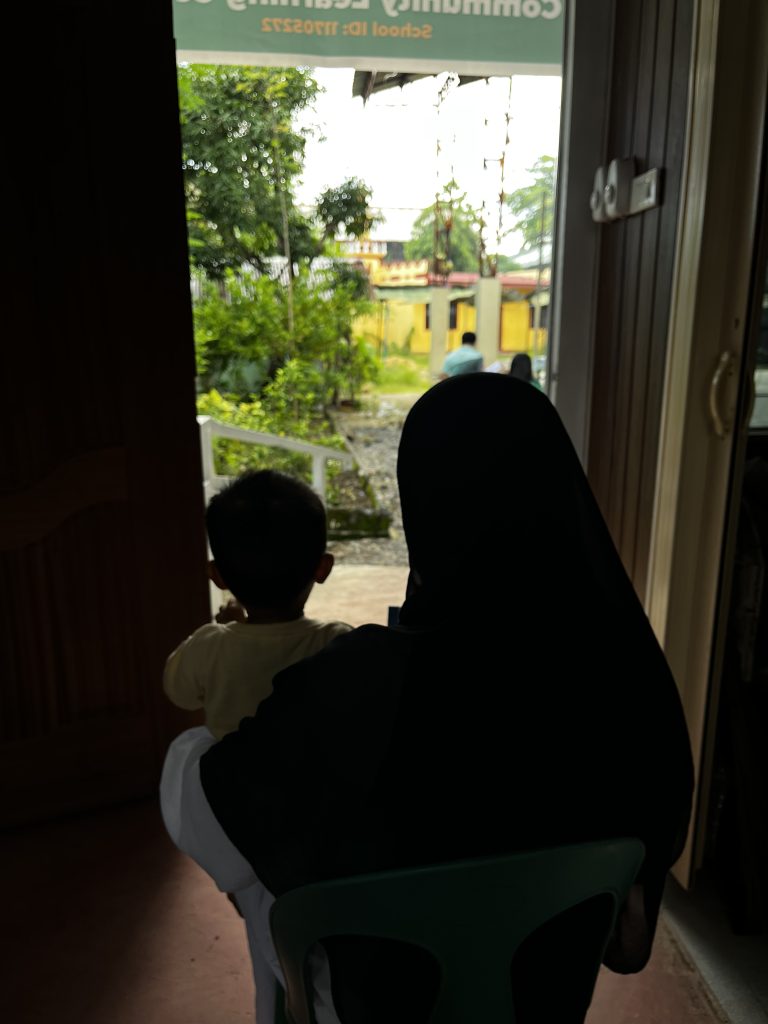
Photo by Alaysa Hadjinor
Every morning in Sultan Kudarat, Maguindanao del Norte, 21‑year‑old Nasema Radzak prepares herself and her two‑year‑old son, Datu Saudi, for school.
But unlike most learners, Nasema does not leave her child behind. For the past 10 months, she has brought him with her to class in Alternative Learning System Community Learning Center (ALS CLC) in their barangay.
This year, she is preparing for the ALS Accreditation and Equivalency (A&E) exam, which recognizes learning equivalent to formal elementary or secondary education and opens opportunities for further study, skills training, or employment.
Nasema ’s formal schooling was interrupted when she became pregnant. Determined to continue learning, she later enrolled in ALS. However, returning to school as a young mother brought different set of challenges.
Without access to childcare, she brought her son to class, where his need for attention often made it difficult for her to focus.
“I really want to study, but it’s very difficult because I don’t have anyone to take care of my child while I’m in class,” Nasema shared.
Balancing learning and caregiving was a daily struggle. Nasema sometimes missed classes, and as the A&E exam approached, finding time to review became even more difficult.
Nasema ’s experience reflects the situation of many young learner‑mothers in the Bangsamoro Autonomous Region of Muslim Mindanao (BARMM). In her ALS‑CLC alone, six out of 116 learners are young mothers.
Across the region, poverty, limited access to secondary schools, and the highest illiteracy rate in the country continue to affect education outcomes. These challenges are further shaped by conflict, instability, and recurring disasters, which place girls and young women at greater risk of leaving school early.
For learner‑mothers, the barriers are even more complex. Care responsibilities are often prioritized over education, and many community learning centers are not designed to support mothers with young children. Without child‑friendly spaces, attending classes regularly and safely can be difficult for both mother and child.

Photo by Alaysa Hadjinor
To help address these challenges, ChildFund Philippines and UNICEF, with support from the Government of the Republic of Korea through the Korea International Cooperation Agency (KOICA), worked with the Bangsamoro Autonomous Region of Muslim Mindanao (BARMM) government to make learning spaces more inclusive for young mothers.
In partnership with the Ministry of Basic, Higher and Technical Education, the Ministry of Health, and the Ministry of Social Services and Development, the project focused on strengthening health and nutrition service delivery across early learning, alternative learning, and community health systems.
Under the project Strengthening Health and Nutrition Service Delivery Capacities in Early Learning, Alternative Learning, and Community Health, partners worked closely with ALS teachers and local stakeholders and identified a key barrier: the lack of childcare for learner-mothers.
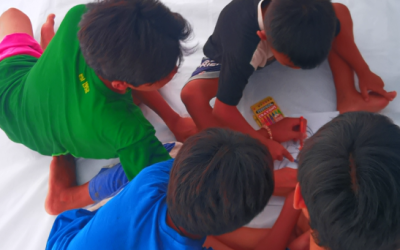
In response, the ALS‑CLC was equipped with a dedicated playroom and child‑friendly learning materials, allowing mothers to attend classes while their children stay in a safe and supervised space nearby.
The center was also enhanced with a breastfeeding area, educational toys, child‑sized furniture, gender‑responsive water and sanitation facilities, and strengthened safety measures for learners.
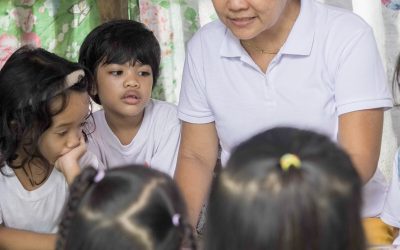
These improvements made a clear difference. Teachers began encouraging learner mothers to bring their children to class, knowing that both could be supported within the same space. With a secure place for her son to play, Nasema began attending classes more regularly. She was also able to focus better, participate more actively, and gain strong understanding of her lessons as she prepares for the A&E exam.

Photo by Alaysa Hadjinor
While the ALS CLC refurbishment was only completed in January 2026, early signs of progress are already evident. According to ALS teacher Fairoz A. Abdulkadir
“Attendance among learner mothers has increased, participation has improved, and more learners are showing readiness for the A&E examination. The learning center has become a more inclusive and welcoming space,” said Fairoz Abdulkadir, ALS teacher.
With the improved facilities, the ALS‑CLC now supports both learning and caregiving. While mothers focus on their studies, their children can play, explore, and interact in an environment designed to support early learning and development.
“The playroom has been a huge help. I can now focus on my studies because I know my child is safe and happy while I’m in class,” said Nasema.
For Nasema and other young mothers like her, the community learning center is no longer just a place to study. It is a space that recognizes their realities—ensuring that, whatever their situation, they are supported to continue learning while caring for their children.